#13 Rethinking Indigenous Knowledge Systems In Children‘s Education: Efik And Igbo Folk Songs Perspectives Of Nigeria
UDC: 784.4(669.1)
COBISS.SR-ID 188649993

Received: Avg 12, 2025
Reviewed: Oct 19, 2025
Accepted: Dec 01, 2025
#13 Rethinking Indigenous Knowledge Systems In Children's Education: Efik And Igbo Folk Songs Perspectives Of Nigeria
Citation: Olaleye, A. Olufemi and O. Stephen Titus. "Rethinking Indigenous Knowledge Systems In Children's Education: Efik And Igbo Folk Songs Perspectives Of Nigeria." Accelerando: Belgrade Journal of Music and Dance 11:13
Abstract
In the African traditional perspectives, music is posited as a medium of communication, education, training, history, sports, proverbs, food, environment, discipline, philosophies, and fosters general societal ideologies. However, several studies failed to unravel these facts. Therefore, this paper focuses on traditional Efik and Igbo folk songs of Southern Nigeria to buttress the multipurpose use assertions with content and context analysis of the songs. This study was based on edutainment theory, which aims to create an environment where learning becomes an enjoyable experience rather than a chore. Content analysis method identifies patterns, themes, meanings, concepts, and significant roles of the traditional Efik and Igbo folk songs of Southern Nigeria, while the context analysis involves examination of the circumstances, conditions, and background factors that influence the songs in broader contexts. The study of Efik and Igbo folk songs calls for urgent attention, so that they will not go into extinction. The survival of indigenous music is a collective role of every indigenous scholar, the government, and educational institutions through research to properly document the roles of traditional Efik and Igbo folk songs of the People of Southern Nigeria.
indigenous knowledge, efik culture, igbo culture, folk songs, children's education introduction, edutainment theory, globalization
Introduction
In every culture, musical heritage has been passed from one generation to another through several means. The manner of transmitting indigenous knowledge is often influenced by the community and environmental factors, with its prescribed code for living. This underlies the reason why children imitate their elders in performing the various art forms practiced, including music. In the submission of Idolo (2002), he posits that no phenomenon void of utility survives in a society, an indication that the presence of music in almost every African society has a formidable role to fulfill. Traditional music is a heritage that weaves cultural conformity to social norms and contributes to the community and stability of society. The way people are reflected in their music. Barber (2018) asserts that popular culture in Africa is unofficial; however, it is determined by ordinary people and not the high-profile class, and it is a non-canonical invention of daily living .
Roles of folk music in the community
This paper examines the roles of Igbo and Efik folk songs in the process of inculcating indigenous knowledge in children in the community. Fundamentally, the common people make folk songs, which Okafor (2002) asserts that in a community, folk songs are part of its memory, life, evaluation, and integration with the continuity of the community. Folk song is an aspect of folklore. Folklore is a concept that embraces the aspect of indigenous, the belief system, the philosophy, customs, superstitions, and the art and crafts of a particular group of people (Ekwueme 2001).
Admittedly, Idolor (2022) opined that folk music is the basis of socialization, enculturation, and documentation of core values, where traditional music artists serve as core drivers to achieve these objectives within the society. Folks work together in their community to preserve their traditional and cultural values. Nwankpa (2022) instructed that African music was covenant with the study of the indigenous music and culture of the Africans. According to him, African music espouses the origin, nature, culture, philosophy, development, characteristics, values, roles, tenets, theory, and practice of music in Africa. To him, this is in contrast with the international knowledge system generated by universities, research institutions, and private firms. It is the basis for local-level decision making in agriculture, health care, food preparation, education, natural-resource management, and a host of other activities in rural communities.
Indigenous knowledge (IK) and local knowledge generally refer to the long-standing traditions and practices of certain regional, indigenous, or local communities. Indigenous knowledge also encompasses the wisdom, knowledge, and teachings of these communities. In many cases, indigenous knowledge has been orally passed down for generations from person to person. Some forms of Indigenous knowledge are expressed through stories, legends, folklore, rituals, songs, and even laws.
Abiodun (2002) declared that each ethnic group has its music peculiar to the culture it practices according to the norms, morals, and the rites guiding the practice, which facilitates communication and decision-making. Indigenous information systems are dynamic and are continually influenced by internal creativity and experimentation as well as by contact with external systems. The term global change encompasses: population, climate, the economy, resource use, energy development, transport, communication, land use and land cover, urbanization, globalization, atmospheric circulation, ocean circulation, the carbon cycle, the nitrogen cycle, the water cycle and other cycles, sea ice loss, sea-level rise, food webs, biological diversity, pollution and health. Global change refers to planetary-scale changes in the Earth system. The system consists of the land, oceans, atmosphere, poles, life, the planet’s natural cycles, and deep Earth processes. These constituent parts influence one another. The Earth system now includes human society, so global change also refers to large-scale changes in society.
Akpabot (1975), Akak (1981, 1982), and Udoh (2012) have studied the historical, musical, and linguistic phonemes of Calabar people. Studies that examine the teaching of indigenous knowledge in Calabar metropolis primary schools using the instrumentation of music performance are not so many. Specifically, the use of Efik folk songs is not available to researchers. The unavailability of documented materials on Efik folk songs for teaching indigenous knowledge in primary school puts cultural heritages, belief systems, and way of life to be at a pitiable situation today.
This paper, therefore, is intended to fill the gap in documentation and analyze the teaching of indigenous knowledge through Efik and Igbo folk songs.
The present clamor by Africans from all quarters to identify with African culture and traditional way of life through music, culture, and values in their entire ramification will make this study relevant. The primary objective of this paper is to investigate how Efik and Igbo folk music performance is used for teaching indigenous knowledge in Calabar primary schools.
The authros will answer the following questions: What is a folk song? What is indigenous knowledge? What are the ingredients of indigenous knowledge? What are the global changes that we have experienced in Africa? What are the challenges of indigenous knowledge in the 21st century? And how do Efik and Igbo folk songs promote indigenous knowledge among the primary school pupils in Calabar?
The origin of Efik
According to Akak (1981), the place now called Calabar is the original home of the Efik, Qua, and Efut ethnic groups. The geographical location of the Efik is latitude 4.45N, longitude 8.17E. Calabar is located on the fringes of the coastal Niger Delta. The word Calabar means come and rest and be at peace with yourself (Erim 2003). The Efik origin has different schools of thought. Akak (1982) asserts that these schools of thought are divided into three: the localists, who believe that the Efiks originated from Nigeria, the continentalists believe that the Efik people came from Africa outside Nigeria, and the orientalists believe that they originated from outside Africa.
Folk Songs in Africa
Folk song is an intellectual artistic creation by the folk and indigenous singers. Its exposition is noted and exists when it is uttered, and passed down from generation to generation of performers who come along in different forms. Traditionally, folk song is the most direct and spontaneous expression of human nature among the indigenous folks. It normally consists of a comparatively simple but complex melody to which several stanzas may belong. Behind each folk song is an amorphous mass of ancestors of the same piece.
Some of the features of folk songs include an art of variation, historical preservation, societal and environmental preservation; however, they change as society changes. The international Folk Music Council (1955) assets that folk song is the product of a musical tradition that has been evolved through the process of oral transmission, and the factors that shape that tradition are continuity that links the present with the past, variation that springs from the creative impulse of individual and the group, and selection by the community which determines the form in which the music survives. The words or lyrics of folk songs are usually the community’s dialect; they reflect the speech patterns and expressions of a particular people. These songs are important primarily because they were first represented with the singing voice rather than being in musical notation. Efik folk songs are basically in this category, which is passed from one generation to another in oral form.
Akpabot (1998) and Okafor (2012) explain that the family concept in societies, especially in Africa, is very strong, and this is reflected in the way they conceptualize their music, which includes folk songs. Efik and Igbo people believe in maintaining their cultural heritage in music, dressing, cooking, entertainment, and neatness.
Folk song is paramount in this place, and with conscientious effort to maintain a customary life in the area of morality and cultural promotion, which are all embedded in Indigenous Knowledge. According to Ekwueme (2001), Folk song performances are generally grouped into gender (male, female, or mixed), age (children, adults, age grade), functions and occasion, professions (guilds, farmers, hunters, etc), society (cultural cults, masquerades, etc). Folk songs are similar. They are all characterized by their structural nature, such as the use of complex rhythms, antiphonal structure, improvisation, oral forms, metric complexity, polyrhythmic, syncopation, functional lyrics, simple and repetitive melodies, drums and percussion as the dominant instruments, and audience participation. Efik and Igbo folk songs are structured with functionality and various forms embedded.
Indigenous knowledge among the Efik and Igbo People
Different scholars have looked into indigenous knowledge as man’s cultural inheritance, plus what he has made of it by his material creation, his arts, sciences, ideas, and philosophy. Besides, the inherited artifacts, good technical process, habits, and values as components of indigenous knowledge.
Akak (1982) explains that these inherited attributes are not just like blue eyes and that indigenous knowledge among the Efik and Igbo people comprises all those things, which are inherited biologically, as used in the social sciences, it refers entire social heritage, all the knowledge, skills, beliefs, and customs he acquires as a member of the society. The Efik culture followed the people from where they migrated to their present place of abode.
Efiong (1996) notes that the colourful Calabar brass trade, embroideries, and other artistic dexterities of the people are part of the indigenous knowledge of the people. One of core components of Indigenous identity and culture and also a vehicle for transmitting traditional values, knowledge systems, and worldviews is the language. Language is a major instrument through which the Efik and Igbo people express their ideals, thoughts, feelings, and sentiments to each other.
Amaku (1984) notes literature, arts, drama, music, dance, ethnics, philosophy, and nationalism. To him Ekpe cult eventually arrived as what is today known as insibidi. Insibidi was used in the identification of labels, public notices, private warnings, declaration of taboos, recording of goods, and money. Also, younger ones must respect elders. Both Efik and Igbo people believe that the supremacy of the ancestors over the living led to the pouring of libation to them as a sign of respect whenever any important ceremony or celebration takes place. Even when there is no occasion for celebration, the Efik people hold the earth with much honor and respect. So when they drink, at least a drop is on the ground.
Indigenous knowledge typically distinguishes one community from another. For some communities, traditional knowledge takes on a personal and spiritual meaning.
Indigenous knowledge can also reflect a community's interests. Some communities depend on their Indigenous knowledge for survival. This is particularly true of traditional environmental knowledge, which refers to a particular form of place-based knowledge of the diversity and interactions among plant and animal species, landforms, watercourses, and other qualities of the biophysical environment in a given place.
Traditional knowledge, on the other hand, may be perceived very differently by indigenous and local communities themselves. The knowledge of indigenous and local communities is often embedded in cosmology, and the distinction between "intangible" knowledge and physical things is often blurred.
Indigenous peoples often say that "our knowledge is holistic, and cannot be separated from our lands and resources". Indigenous knowledge in these cosmologies is inextricably bound to ancestors and ancestral lands. Knowledge may not be acquired by naturalistic trial and error, but through direct revelation through conversations with the creator, spirits, or ancestors. Indigenous and local communities often do not have strong traditions of ownership over knowledge that resemble the modern forms of private ownership.
Warren (1991) views that many have clear traditions of custodianship over knowledge, and customary law may guide who may use different kinds of knowledge at particular times and places, and obligations that accompany the use of knowledge. From their perspective, misappropriation and misuse of knowledge may be offensive to traditions and may have spiritual and physical repercussions in their cosmological systems. Subsequently, indigenous and local communities argue that others' use of their traditional knowledge warrants respect and sensitivity.
Indigenous knowledge provides the basis for problem-solving strategies for local communities, especially the poor. Flavier (1995) asserts that it represents an important component of global knowledge on development issues. Indigenous knowledge is an underutilized resource in the development process.
Learning from Indigenous knowledge, by investigating first what local communities know and have, can improve understanding of local conditions and provide a productive context for activities designed to help the communities. Understanding Indigenous knowledge can increase responsiveness to clients.
Adapting international practices to the local setting can help improve the impact and sustainability of development assistance. Sharing Indigenous knowledge within and across communities can help enhance cross-cultural understanding and promote the cultural dimension of development.
Integrating Indigenous knowledge (IK) into development assistance programs is widely recognized as a critical strategy for enhancing project sustainability, poverty reduction, and aid effectiveness. This approach leverages time-tested, local expertise to create culturally appropriate solutions in agriculture, healthcare, and environmental conservation. (Mwantimwa 2009)
The integration of IK into the development process is essentially a process of exchange of information from one community to another. The process of exchange of IK within and between developing countries and between developing and industrial countries involves essentially six steps:
- recognition and identification: some IK may be embedded in a mix of technologies or in cultural values, rendering them unrecognizable at first glance to the external observer (technical and social analyses may, therefore, be required to identify IK)
- validation: this involves an assessment of IK’s significance and relevance (to solving problems), reliability (i.e., not being an accidental occurrence), functionality (how well does it work?), and effectiveness and transferability
- recording and documentation is a major challenge because of the tacit nature of IK (it is typically exchanged through personal communication from master to apprentice, and from parent to child). In some cases, modern tools could be used, while in other circumstances it may be appropriate to rely on more traditional methods (e.g., taped narration, drawings)
- storage in retrievable repositories (storage is not limited to text document or electronic format. It could include tapes, films, storytelling, gene banks, etc.)
- transfer: this step goes beyond merely conveying the knowledge to the recipient
- testing of the knowledge in the new environment. Pilots are the most appropriate approach in this step, and dissemination to a wider community adds the developmental dimension to the exchange of knowledge and could promote a wider and deeper ripple impact of the knowledge transfer. Exchange of IK is the ideal outcome of a successful transfer and dissemination. This is essentially a learning process whereby the community where an IK practice originates, the agent who transmits the practice, and the community that adopts and adapts the practice all learn during the process.
Global Changes That Affect Indigenous Knowledge in Efik and Igbo Culture
The global change includes:
- adaptation,
- governance,
- education,
- indigenous knowledge,
- science policy and society,
- capacity building (i.e., capacity recognition and development, which needs to recognize that there is capacity in Africa),
- assessment, and
- monitoring.
Gray (2000) asserts that globalization is understood to mean major increases in worldwide trade and exchanges in an increasingly open, integrated, and borderless international economy. There has been remarkable growth in such trade and exchanges, not only in traditional international trade in goods and services, but also in exchanges of currencies, in capital movements, in technology transfer, in people moving through international travel and migration, and in international flows of information and ideas.
A third source of globalization is changes in institutions, where organizations have a wider reach, due, in part, to technological changes and to the more wide-ranging horizons of their managers, empowered by advances in communications. Thus, corporations that were mainly focused on local markets have extended their range in terms of markets and production facilities to a national, multinational, international, or even global reach. These changes in industrial structure have led to increases in the power, profits, and productivity of those firms that can choose among many nations for their sources of materials, production facilities, and markets, quickly adjusting to changing market conditions.
Bauman (1998) asserts that global change in a societal context encompasses social, cultural, technological, political, economic, and legal change. Terms closely related to global change and society are globalization and global integration. Globalization began with long-distance trade and urbanism.
The first record of long-distance trading routes dates back to the third millennium BC. Sumerians in Mesopotamia traded with settlers in the Indus Valley, in modern-day India. Since 1750, but more significantly, since the 1950s, global integration has accelerated. This era has witnessed incredible global changes in communications, transportation, and computer technology. Ideas, cultures, people, goods, services, and money move around the planet with ease. This new global interconnectedness and free flow of information have radically altered notions of other cultures, conflicts, religions, and taboos.
Now, social movements can and do form at a planetary scale. Evidence, if more were needed, of the link between social and environmental global change came with the 2008-2009 global financial crisis. The crisis pushed the planet’s main economic powerhouses, the United States, Europe, and much of Asia, into recession. According to the Global Carbon Project, global atmospheric emissions of carbon dioxide fell from an annual growth rate of around 3.4% between 2000 and 2008 to a growth rate of about 2% in 2008 (Bauman 1998 ).
According to Dickens (1998), global change means a multi-dimensional movement in the patterns of economic activity, from predominantly national to international, transnational, and global levels – all still territorially based – which are complexly described and analyzed.
Bauman (1998) asserts that globalization is one of the new speeds and fluxes, which divides humanity between the haves and have-nots of cyberspace. To him, rather than homogenizing the human condition, he avers, the technological annulment of temporal-spatial distances tends to polarize it. Elites have chosen cybernetic isolation, but the rest of the population is cut off and forced to pay the heavy cultural, psychological, and political price of their new isolation. New global media are not truly interactive, but privilege a small global elite, while the many use media only to watch the celebrities of this elite, celebrating their lifestyle.
In globalized politics, according to Bauman, nothing is left of the older universalizing discourse which declared an intention to make the similar life-conditions of everyone and everywhere, and so everybody’s life-chances. Perhaps even make them equal. Globalization refers primarily to the global effects, notoriously unintended and unanticipated, rather than to global initiatives and undertakings. It's not about what we all, or at least the most resourceful and enterprising among us, wish or hope to do.
Even its original meaning, the understanding of the world as a sphere, was imbued with a new consciousness of the common environment of humankind, a consciousness which has greatly grown in recent decades. However, the understanding of the global has increasingly carried with it the sense of a common human society which involves more than mere technical linkages. Increasingly, the global is seen to involve a new social life.
Formal Education and Indigenous Education among Efik and Igbo people
The indigenous education system was prevalent in Africa before the arrival of Christianity or Islam. Every society in Africa, including the Efiks and Igbo, has its method of training and educating its young ones. Children learn by doing and imitating elders. In another wordsm children and adolescents engage in participatory education. Education is very elusive and cannot easily be pinned down. Education is defined when related to culture, and is said to be the revival of culture and transmission. Also, it embraces all societies, literate and non-literate, industrialized and non-industrialized, and uses culture to embrace people’s arts, folk songs, and values.
Education in the indigenous method is the culture that each generation purposely gives to those who are to be its successors, to qualify them for at least keeping and, if possible, for raising the level of improvement that has been established and attained.
The Igbo and Efik ethnic group, like other ethnic groups in Nigeria, have their young ones. As earlier mentioned, the home of Efik and Igbo is rich in cultural activities, which include literature, arts, drama, music, dance, philosophy, and mathematics. In Efik, Nsibidi was used in the identification of labels, public notice, private warning, declaration of taboos, recording of goods, and counting of money (Efiong 1996). Even when schools started in Calabar, their natural love for literacy culture formed part of their daily life and pleasure as expressed in their traditional literature in the form of stories about their ancient history and their natural life as a whole. Songs, proverbs, and metaphors bring out a vivid record of their origin, migration, settlement, and achievement.
Dramatic culture, which expresses itself in Igbo and Efik dramas and depicts the tradition of the people from their origin, has been used in staging their indigenous plays in the form of concerts, dramas, and cultural dances. These entire cultural heritages are passed on to the younger generations through indigenous education. Children are integrated into the wider society through carefully planned programs of initiation, festivals, and the age-grade system. Home education was training for participation throughout one’s life, and it includes training in allegiance, mutual interest, and independence from one another.
The most crucial aspect in indigenous education was in relevance to individuals and the societal needs and aspirations. The system was arranged to develop the spirit of love and patriotism, and to become a self-supporting adult. Mathematics, correct speech, history, physical education, and all aspects of culture are included in the education people give to the young ones (Akak 1981). Indigenous education of children, especially through the folktale and folk singing, happens at any time of the day and most especially at night. Children will gather around the elderly man who is telling them stories and singing songs that accompany them. All these indigenous methods have been imported to the formal education of children in primary schools in Calabar, where they make use of the folk songs in teaching number/mathematics, elementary science, and history.
In Igbo culture, children are regarded as a product of nature and nurture, with some natural traits that are influenced by the prevalent social habits and environmental circumstances. The Igbo names identify their environment, sentiments, and general life aspirations.
The below song is an Igbo traditional children's folksong titled Nne nne, usually sung during play. The song focuses on the mother’s calabash that fell off and broke on the way home from the river. The call and response song is notated in 21 bars on the anacrusis starting point. The beauty of this children's folk is the dramatic display of the mother, her calabash, the water, and the playful pouring of water by an old woman expected to be a wise elderly mother.

Example 1. Nne nne song.
Bena, my sibling, is a cradle of the Igbo people of eastern Nigeria. Bena is the name of a person, and the performer assumes that Bena is her sibling who has a penchant for sweet things like sweets, chewing gum, and chocolates. The playful song projected restlessness in Bena's appearance wherever there are sweeties.

Example 2. Bena,my sibling.
The song number three, titled Tatando, which means sorry baby, is an Igbo lullaby song used to put the baby to sleep. An interesting aspect of the song is the last phrase, ‘we will cook yams for the baby’, used to deceive the baby, just to enable him to stop crying.

Example 3. Tatando (sorry baby).
Udara Muto is another interesting Igbo children's play song. The song pleaded that cherries should grow for the sake of an orphan. The Igbo children make use of this song whenever they want to eat cherry fruits.

Example 4. Udara Muto (cherries for the orphan).
Kedu Onye is an Igbo song by the children seeking friendship. The phrase who will be my friend and I have seen my friend, depicts an interest to play to experience.

Example 5. Kedu Onye (who will be my friend).
The song Gba ka nne gi si agba (dance like your mother). This song is an interesting moonlight play song that the Igbo children use to transmit their mothers' dance steps to themselves. The funny song is used to replicate their mothers' dance steps in the community.

Example 6. Gba ka nne gi si agba (dance like your mother).
Ka m fe Chukwu is song number seven, which is used by the little children during a traditional festival to praise God and to express their minds about the superiority of the almighty God. Generally, Igbo people are highly religious people with constant reference to God as the creator of the universe.

Example 7. Ka m fe Chukwu (I praise God).
Akwukwo means ‘school’. The song teaches the children the importance of attending a school with emphasis on how interesting schooling is. The future is depicted as bright if little children attend school.

Example 8. Akwukwo (school).
Onye Ga Gba Egwuis an Igbo traditional folksong used for children's competition to select the best dancer among their peers.
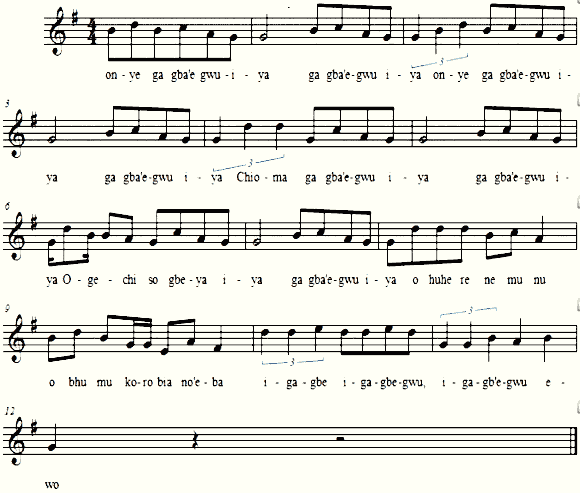
Example 9. Onye Ga Gba Egwu (who will be the best dancer).
Roles of Igbo and Efik Folk Songs in Teaching Indigenous Knowledge
Igbo and Efik folk songs oblige diverse functions, especially among the pupils in primary schools. Ranging from social, moral, religious, to the political system in the indigenous way of life. It has functioned so much in entertainment, as most members of society were normally intrigued to watch the performances. Igbo and Efik folk songs, though they have historical facts connected to time, place, events, vice, and effects, are not just narratives of detached facts that are functionally ephemeral. They are songs whose poetry focuses on, and employs nature and metaphysical imagery, as well as wise sayings and inveterate philosophical wisdom of common experiences to people in Calabar, especially pupils in schools. Cultures that are capable of fixing congruous ideas into the minds of listeners.
Laura (1998) comments on the functions of music in society, arguing that Performance as entertainment can make people happy. According to him, Songs can make people forget about death and fighting, and words of some songs remind people of past times and of other occasions for praise singing, because praise singing occurs during parties, celebrations, or other events that call for entertainment.
Efik and Igbo folk songs do not aim at providing just temporary happiness in entertainment. It does not give momentary joy that makes people forget about the realities of life. It presents issues of the moment and provides stimulus to rethink behaviors that are contrary to the norms of society, and such vices that could even be dangerous to those who indulge in them and society. It prompts members of the society to examine and address facts about reality
Education and Enlightenment
Efik folk songs have played significant roles in educating and enlightening the pupils. Ifionu (1982) notes that besides its entertainment and aesthetic values, music in some contexts may be either a means of infusing a sense of unity and oneness in the minds of the people or of expressing emotions or thoughts, ideas, or comments which cannot be stated boldly in normal language situation.
Music functions as a vehicle of continuity and stability of culture. Most Efik folk song themes are educative, either by use of direct statements or by use of Idioms, epigrammatic, and proverbs that are poetically structured to stimulate further reasoning and realization of meaning through deduction.
The songs range from the civic roles of individuals in the society, which include love for one's paying of tax, to the government obeying the rules and regulations of the government, even during the electioneering of the Yagba society. Electioneering in the Yagba Federal Constituency of Kogi State, Nigeria, is characterized by a shift towards performance-based politics, strong grassroots mobilization, and a focus on continuity in representation, particularly around key figures.
Folk songs educate on the danger of HIV/AIDS, censors, folk songs educate parents on the need to train their children and pay school fees, and folk songs enlighten youths to be focused in life and not to be derailed by lust, hard drugs, and other vices. The following song exemplifies this point:
Nnam finso namfinso, imassin ufok iyeting
Nnam finso namfinso, imassin ufok iyeting
Edio, dida yami dida yami nfin
Edio, dida yami dida yami nfin
Damiyon, damiyon, masim obioroyekut nne mi do
Damiyon, damiyon, masim obioroyekut nne mi do

[what have I done to you?
when we get home
we shall discuss
come and be with me today
take me home
when we get home we shall see my grandmother there]
The song Nnam Fin So is teaching pupils the need for friendship in society and within the school system. As we relate together as human beings, we are bound to offend one another, but we must, as a matter of fact and brotherhood, readily forgive one another

Example 10. Nnam Fin So (what have I done to you).
Folk song as a source of mental development
The psychological development of children is imperative. Therefore, through folk songs, children learn how to count, numbers, spelling, and recite parts of their bodies. Learning begins at the cradle, and as the child grows, his active response to his environment shapes the development of his intelligence. Children's speech, as well as their physical dexterity and formulation of concepts, are intertwined in indigenous knowledge and principles. The song below is an example of an Efik folk song on mental and psychological development:
Nne mi nne mi, nso isi neke abang yohoyoho
Mme enye ne eyen
Aninin tininin enyeno, anini tininin
Mme enye ne enyin
Aninin tininin enyeno, anini tininin
Mme enyen u tong Aninin tininin enyeno, anini tininin

[mummy, what is inside the pot
and making the sound yohoyoho
does it have legs?
does it have hands?
does it have teeth?
does it have a hands?]
This song identifies the different parts of the body to children and helps pupils to understand the different parts of humans or animals.
Caution, Correction, and Counsel in Efik Folk Songs
The function of music in warning and counseling members of society is paramount in Africa. Efik folk songs warned and counseled pupils against some wanton attitudes and practices that could result in painful experiences. Some of the warnings and counsel are sometimes directed to individuals. Burton and Chacksfield (1979) remark that in all countries, poets and singers are idealists. To them, their idealism makes them sensitive to the faults that they see in their nation and quick to condemn those faults, and they resent bitterly any failure to achieve the high standards that they value. The song below is an example:
Saya nak o, saya nak o
Idiyie ofo akeyene saya nak o

[leave it alone, leave it there, you are not the owner
leave it there]
The song is a caution to those who steal what is not theirs, that they should stop stealing. Here we have direct teaching on being a good citizen and an upright young mind. The song warns, corrects, and informs young people about the need to be faithful and not to touch what does not belong to them. This is crucial in the current age, where people are willing not just to take what is not theirs but to kill the owners of such materials. Nigeria, with a culture of corruption, needs such morally induced songs.
Folksong as Entertainment music
African music is entertainment, praise, and recommendation-based. Peterson (1993) writes that the tradition of praise singing is an important one in many African states, most notably, Senegal, Gambia, Guinea, Mali, Nigeria, and South Africa. To him, they are oral (praise singers) historians, the preservers of culture. Efik folk song performs the function of praise and commendation to deserving members, to encourage such persons who are doing well in society to continue in their good deeds, as well as stimulate others to emulate them.
Ekong nke o, iya, ekong nke o iya, nke nke nke
Ekong nke o, iya, ekong nke o iya, nke nke nke nke

[story story I want to tell you a story
story story I need to tell you a story]
This song tells the stories of various Efik cultural traditions and indigenous knowledge. Some of the stories are the tortoise and the hare. Moonlight stories on faithfulness, morality, and respect for elders among the Efik are naturally passed through the moonlight stories and songs that accompany them. Burton and Chacksfield (1979) remark that traditional songs tell stirring stories, express strong emotions such as love, hate, or jealousy, or depict intense states of mind such as adoration, ecstasy, or despair. Efik folk songs tell stories of political development, love affairs, dedication, faithfulness, drunkenness, envy, and miserly activities to stir up emotions and despair among the audience.
Folk Songs on Praise and Commendation
African music is entertainment, praise, and recommendation-based. Peterson (1993) writes that the tradition of praise singing is an important one in many African states, most notably, Senegal, Gambia, Guinea, Mali, Nigeria, and South Africa. They are oral (praise singers) historians, the preservers of culture. Arntson (1998) argues that performance as entertainment can make people happy, and praise singing occurs during parties, celebrations, or other events that call for entertainment. Efik folk songs perform the functions of praise and commendation to deserving members, to encourage such persons who are doing well in society to continue in their good deeds, as well as stimulate others to emulate them.
Sansang aparawa mi
Sansang aparawa mi
Sansang aparawa mi
Abasi odion fi

[thank you my boy
thank you my boy
thank you my boy
God bless you]
The song above reminds one of the praises and commendations that usually follow good deeds. In this particular song, the father praises his son for several reasons. One of these is the fact that the child helps in the home, runs errands, and can maintain the good name of the family outside the home. That is, the child did not bring disgrace to the family, and on that note, the child is praised and blessed.
Socio-Cultural Identities
Music, generally as an aspect of culture, functions in identifying cultural and ethnic groups, and in the spirit of performers-audience participation, creates the sense of belonging to an identified group. Allen (1993) writes that people living through periods of fundamental social change generally suffer deep crises of identity, and their search for a way of making sense of their existence manifests in cultural forms such as musical style. This is not an exception in Efik folk songs.
Ekiko yoro yoro yoro
Ekiko yoro yoroyoro
Ekiko yoro yoro yoro
Ekiko yoro yoro yoro
Afuro wan wawawa, wa, wawawa

[chicken that raises its feathers
chicken that raises its feathers
chicken that raises its feathers
chicken that raises its feathers
yet it cannot fly so far]
The song above explains that the chickens sometimes raise their feathers like the eagle. Though it may be able to fly just for a little height, it should never compare itself to an eagle. The song teaches about knowing one's boundaries and limitations in life. Yet everyone has all the opportunities that nature has bestowed on them. We should not compare ourselves or try to imitate others. Also, using another man’s watch for oneself is foolishness, which the song teaches.
Conclusion
The paper looked at Igbo and Efik folk songs and their place in teaching indigenous knowledge in Southeast Nigeria. It discussed the elements of indigenous knowledge, global changes in Africa, in the challenges of the 21st century. The paper recommended that indigenous music practitioners should be empowered by giving some allowances every month to the artists. Music teachers in schools should be encouraged by giving extra incentives. Principals, school administrators, and proprietors should encourage music and especially folk song in their schools. Also, the present administration should reorganize its cabinets so that they can give good, indigenous knowledge and quality education to our children, so that the cultural and value system in Africa can be preserved.
End Note
Isibidi is an indigenous way of counting and reading among the Efik people Ekpe is an indigenous festival observed by the Efik people of Calabar
References
- Abiodun, F. 2002. “The Use of Traditional Music Elements in Nigerian Art Composition: Strategic Principles for its Functions Usage.” The Gourd Rattles Journal of Musicology 1: 38–46.
- Akak, E. O. 1981. Efiks of Old Calabar: Origin and History. Calabar: Barose Press, Vol. 1.
- Akak, E. O. 1982. Efiks of Old Calabar: Culture and Superstitions. Calabar: Paicco Press, Vol. 2.
- Akpabot, S. E. 1998. Form, Function and Style in African Music. Lagos: Macmillan Nigeria Publishers Ltd.
- Akpabot, S. E. 1975. Ibibio Music in Nigerian Culture. East Lansing: Michigan State University Press.
- Amaku, E. N. 1933. Ufot Uto Iko Efiks. Calabar: University Press.
- Amankulor, J. N. 1981. “Ekpe Festival as Religious Ritual, Dance and Drama.” In Drama and Theater in Nigeria: A Critical Source Book, edited by Yemi Ogunbiyi. Lagos: Nigeria Magazine.
- Arntson, L. 1998. “Praise Singing in Northern Sierra Leone.” In Africa: The Garland Encyclopedia of World Music, edited by Ruth Stone. New York: Garland Publishing Inc.
- Bauman, Z. 2000. Globalization. New York: Columbia University Press.
- Burton, S. H., and C. J. H. Chacksfield. 1979. African Poetry in English: An Introduction to Practical Criticism. London: Macmillan Press Ltd.
- Dicken, Peter. 1998. Global Shift: Transforming the World Economy. 3rd ed. London: Paul Chapman Publishing Ltd.
- Efiong, E. C. 1996. Calabar: The Concept and Its Evolution. Calabar: University Press.
- Ekwueme, I. 2001. “Documentation of Folk Music: Trends, Challenges and Prospects for Nigerian Indigenous Music.” Nigerian Music Review 2(2): 17–28. Ile-Ife: Dept. of Music.
- Erim, E. 2003. “Vanguard Interview on the History and Culture of Efiks.” October 2: 4–5.
- Flavier, J. M. 1995. “The Regional Program for the Promotion of Indigenous Knowledge in Asia.” In The Cultural Dimension of Development: Indigenous Knowledge Systems, 479–487. Edited by D. M. Warren, L. J. Slikkerveer, and D. Brokensha. London: Intermediate Technology Publications.
- Gray, John. 2000. False Dawn: The Delusions of Global Capitalism. New York: New Press.
- Idolo, E. 2002. “Music to Contemporary African.” In Music in Africa: Facts and Illusions, 1–11. Edited by E. Idolor. Ibadan: Sterling-Horden Publishing (Nig.) Ltd.
- Ifionu, A. O. 1982. The Role of Music in Igbo Culture. Ibadan: University Press.
- IFMC. 1955. “Notation of Folk Music.” Recommendation of the Committee of Experts. Geneva.
- Merriam, A. P. 1964. Anthropology of Music. Evanston: Northwestern University Press.
- Mwantimwa, Kelefa. 2009. “The Relationship of Indigenous Knowledge and Technological Innovation to Poverty Alleviation in Tanzania.” Paper presented at the VI Globelics Conference, Mexico City, September 22–24, 2008. researchgate.net
- Nwankpa, Onyee N., and I. N. Clare. 2022. “Ethos in Nigerian Music: Moving the Creative Industry to Creative Economy.” Journal of the Association of Nigerian Musicologists 16(1): 196–215.
- Okafor, R. C. 2002. “Vintage in New Bottles, Packaging and Repackaging the Music Culture of Nigeria.” Interlink Journal of Research in Music 1(1): 150.
- Okafor, R. C. 2012. “Music and Nigerian Socio-cultural Integrity.” Nsukka Journal of Musical Arts Research 1: 1–18.
- Samuel, K. M. 2009. “Female Involvement in Dundun Drumming Among the Yorùbá of Southwestern Nigeria.” Unpublished PhD diss., University of Ìbàdàn.
- Seeger, C. 1975. “Accurate Measurement of Pitch in Songs.” African Music 1 (4): 55–64.
- Soul City. 2002. Edutainment: The Soul City Approach. comminit. Accessed July 24, 2010.
- Titus, S. O. 2012. “The Role of Music in Peaceful Co-existence Among Religious Bodies in the Ede Community.” Paper presented at the workshop organized by Osun State University and University of Birmingham on Everyday Life in Ede Community, Adeleke University, November 12–15, 2012.
- Titus, S. O. 2013. “Structure and Function of Iregun Music in Yagbaland, Kogi State, Nigeria.” Unpublished PhD diss., University of Ìbàdàn.
- Udoh, I. E. 2012. “The Integrity of Traditional Music in the Nigerian Society: A Case Study of Annang Music.” Nsukka Journal of Musical Arts Research (NJMAR) 1: 119–130.
- Warren, D. M. 1991. “Using Indigenous Knowledge in Agricultural Development.” World Bank Discussion Paper 127. Washington, D.C.
