#16 The First Polish National Ballet: The Krakow Wedding. Origins, Adaptations, And Legacy
UDC: 782.071.1 Крупињски К.
     316.752(438)
COBISS.SR-ID 188680713

Received: May 21, 2025
Reviewed: Sep 08, 2025
Accepted: Dec 02, 2025
#16 The First Polish National Ballet: The Krakow Wedding. Origins, Adaptations, And Legacy
Citation: Carlos-Machej, Klaudia. 2026. "The First Polish National Ballet: 'The Krakow Wedding'. Origins, Adaptations, And Legacy." Accelerando: Belgrade Journal of Music and Dance 11:16
Abstract
Throughout the nineteenth century, artistic expression functioned as a means of manifesting attachment to Polish national identity and of sustaining it within the consciousness of successive generations. Music and dance not only cultivated aesthetic sensitivity but also became powerful instruments of resistance against the partitioning powers. The theatre stage served as a space for the stimulation of patriotic sentiment and the preservation of indigenous traditions. The ballet also represents one of the earliest attempts to integrate elements of Polish folklore with established forms of classical dance. This paper examines the origins, adaptations, and legacy of Wesele w Ojcowie ("The Wedding in Ojców"), a ballet that became a symbol of Polish national identity. The Wedding in Ojców" attracted the interest of Anna Pavlova, who herself performed the role of Zośka, partnered by Mieczysław Pianowski. Wesele w Ojcowie was also presented by the Polish Ballet ensemble, including performances on the French Riviera and at the World’s Fair in New York in June 1939. After 1945, one of the most significant stagings of Wesele w Ojcowie was created by the distinguished dancer and choreographer Witold Gruca, who collaborated with Janina Pudełek, a prominent advocate of Polish national dances. Their collaboration left a lasting impact on the development of Polish ballet. The premiere of Wesele w Ojcowie ("The Wedding in Ojców"), choreographed by Witold Gruca, became a highlight of the theatrical season. Gruca demonstrated both creativity and inspiration, treating dance as a medium for the expression of emotion and feeling, confirming that “It is not worth dancing ‘empty’; for the sake of dancing itself, one must tell a story through dance” (Witkiewicz 2004, 19). The author sincerely hopes that this legacy of the ballet will inspire future generations of Polish dancers and choreographers, concluding that keeping alive the memory of Wesele w Ojcowie ("The Wedding in Ojców") in Poland is a responsibility we all share.
national identity, polish folk dances, music, dance, ballet, dancers, choreographers
Introduction
The premiere of Wesele krakowskie in Oyców (The Krakow Wedding) took place at the National Theatre in Warsaw on 14 March 1823. The ballet's appeal is largely due to its libretto, written by Banawentura Kudlicz and inspired by the customs of the Małopolska (Krakow) region. The plot is set in a village near Ojców and depicts the wedding ceremony of a young couple.
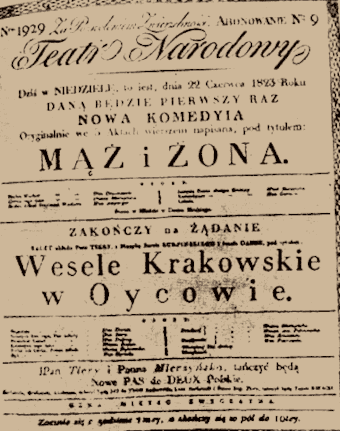
Picture 1. Poster Wesele krakowskie in Oyców (The Krakow Wedding), National Theatre in Warsaw 1823
The wedding celebration provided an opportunity to showcase the beauty of Polish dance as a medium for conveying knowledge about national culture and customs. In rural communities, a wedding was not only the most important family event but also a symbolic union of the entire village. Accordingly, the ballet features a wide range of characters, including Szczepan, the groom and the organist’s son, Zośka, the bride and the farmer’s daughter, the organist, the farmer Stanisław and his wife Katarzyna, the first bridesmaid, Bąk, as well as bridesmaids, groomsmen, villagers, and peasant women (Turska 1989, 369).
A key figure in the ballet’s premiere was Julia Mierzyńska, the favourite of Warsaw audiences and the company’s principal dancer. She co-created the choreography together with Maurice Pion and Ludwik Thierry and also performed the role of the first bridesmaid. This one-act ballet was prepared for Mierzyńska’s benefit performance, and her virtuosic mazurka solo became a lasting t est of technical mastery and expressive skill for subsequent generations of dancers.
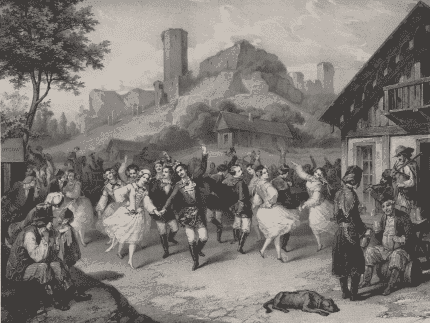
Picture 2. Lithography. Wesele krakowskie in Oyców (The Krakow Wedding), P. Gavrani after drawing by P. Zalewski, 1852, (The Theatre Museum in Warsaw)
The National Theatre at Krasiński Square in Warsaw
It is worth mentioning that for almost 70 years, the National Theatre at Krasiński Square in Warsaw served as the Polish national stage. It was the third major theatrical venue after the Saska Opera House and the Radziwiłł Palace. The project’s patron, Franciszek Ryx, entrusted the design and construction to Bonawentura Solari, a member of a family of Italian architects who later became Polish citizens. The theatre was designed to serve King Stanisław August Poniatowski as well as the audience that actively participated in the cultural life of the capital. A special ceremonial entrance from the side of the Krasiński Palace, marked by a portico, was designed for the king, who had a private apartment within the theatre, providing him direct access to the stage.
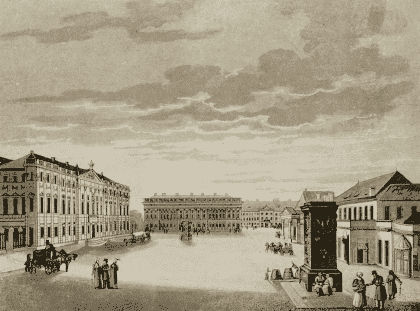
Picture 3. Engraving: View of Krasiński Square in Warsaw, F. Dietrich (CBN Polona)
The audience, seated in a fully illuminated auditorium, could observe the artists – His Majesty's National Dancers – from both the ground floor and the gallery, accompanied by musicians located beneath the stage. The central section of the first floor was reserved for guests of honour. The king himself occupied the second box closest to the stage, from where he could enjoy various performances: comedies, tragedies, dramas, operas and ballets. The repertoire included works by Shakespeare, Molière and Mozart.
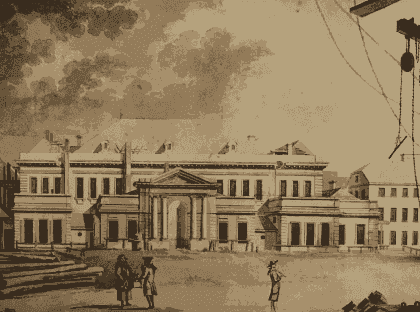
Picture 4. Engraving: Public theatre on Krasiński Square in Warsaw, Z. Vogel (The National Museum in Warsaw)
The national stage on Krasiński Square was managed by impresarios, among whom Wojciech Bogusławski emerged as the leading figure. His vaudeville Cud mniemany, czyli Krakowiacy i Górale [“The Supposed Miracle, or Krakowiacy and Górale”], created in collaboration with Jan Stefani, established the lasting presence of national themes on the Polish stage.
During the period following Poland’s loss of statehood, music and dance not only cultivated aesthetic sensitivity but also became powerful instruments of resistance against the partitioning powers. The theatre stage served as a space for the stimulation of patriotic sentiment and the preservation of indigenous traditions. Throughout the nineteenth century, artistic expression functioned as a means of manifesting attachment to Polish national identity and of sustaining it within the consciousness of successive generations.
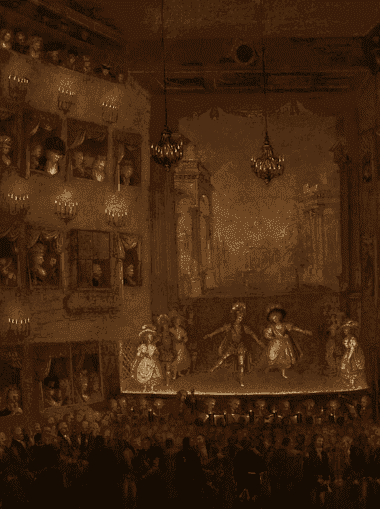
Picture 5a. Engraving: Opera Pirro, Scamozzi (The National Museum in Warsaw)
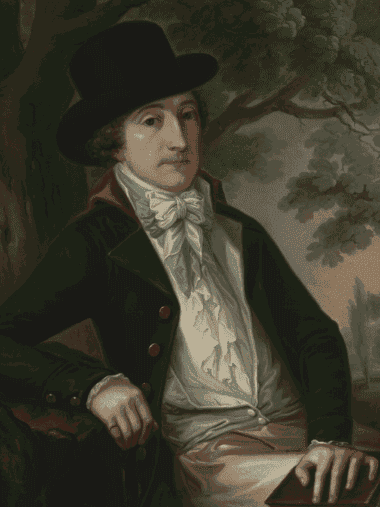
Picture 5b. Wojciech Bogusławski (The National Museum in Warsaw)
The Ballet music and choreography
The music for the ballet, drawing on motifs from Jan Stefani’s opera Cud mniemany, czyli Krakowiacy i Górale [“The Supposed Miracle, or The Cracovians and the Highlanders”], was composed by Karol Kurpiński and Józef Damse. Kurpiński’s contribution to the development of national music was particularly significant. By infusing his compositions with intonations and rhythms derived from diverse strata of Polish folklore, he
substantially strengthened the relationship between professional art music and folk traditions. In doing so, he artistically transformed Polish musical folklore and established a model that would later be developed by composers such as Fryderyk Chopin and Stanisław Moniuszko. (Przybylski 2007, 12)
The music, grounded in folk motifs, endowed the ballet with a distinctive and national character, while its choreography contributed decisively to the work’s lasting presence in the Polish ballet repertoire. As the Polish dance historian Irena Turska observed, The Wedding in Ojców
owes its enduring position primarily to its music, rooted in Polish folk dances, graceful in its idyllic stylisation, rich in melodic invention, and marked by vitality and verve. The ballet also exhibits some of the earliest attempts to integrate elements of Polish folklore with established forms of classical dance, such as the Polish pas de deux, the Kraków pas de trois, and the solo mazurka of the first bridesmaid. (Turska op. cit., 370.)
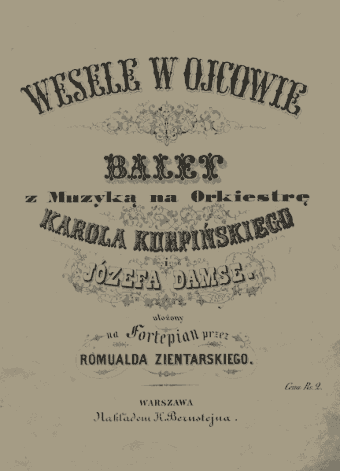
Picture 6a. Engraving: Wesele w Ojcowie, CBN Polona (Wesele w Ojcowie, musical notes ca.1865)
The musical structure of the ballet comprised the following sections: an Overture (4/4, allegro); an Introduction (Introdukcya) (4/4, moderato); a Krakowiak; a moderato section (3/4); a March; a Mazurka (3/8); and a Coda (3/8). This was followed by a moderato and an andantino (4/4), leading to an alla Krakowiak and a Krakowiak. A solo mazur, composed by Józef Damse (3/8), was succeeded by a Coda (3/8). The ballet also included an andante pas de trois (4/4), consisting of a theme (2/4), a coda (2/4), a second theme (2/4), three variations (2/4), and a concluding coda (2/4). The work concluded with a Krakowiak by Józef Elsner, an Obertas by Karol Kurpiński (3/8), and a final coda.
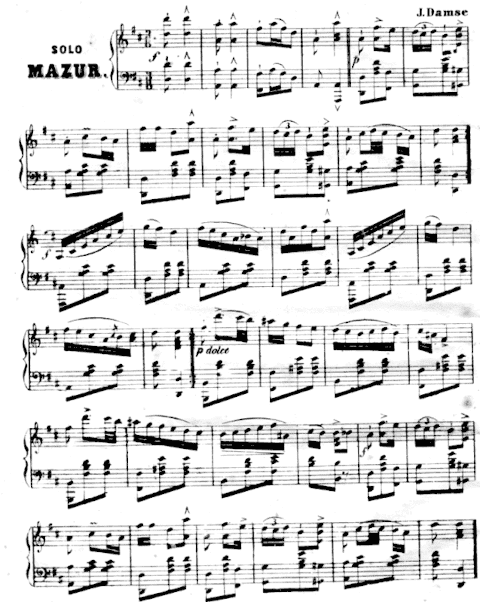
Picture 6b. Engraving: Solo-mazur, music by J. Damse, CBN Polona (Wesele w Ojcowie 1865). Source: polona.pl, accessed December 30, 2025.
The ballet also represents one of the earliest attempts to integrate elements of Polish folklore with established forms of classical dance, exemplified by such choreographic structures as the Polish pas de deux, the Kraków pas de trois, and the solo mazurka performed by the first bridesmaid (Ibidem.).
Outstanding performers who ensured the ballet’s longlasting success
This first Polish national ballet achieved remarkable popularity. Wesele w Ojcowie (The Wedding in Ojców) featured many of the most prominent artists of the nineteenth-century Warsaw stage, including Felicja Dąbrowska, Ludwika Reppe, Antonina Palczewska, Karolina Bizos, and Ludwik Thierry, as well as Konstancja and Roman Turczynowicz, Maria Oliwińska, Matylda Dylewska, Ludwik Kuhne, Aleksander Gillert, and Władysław Przedpełski. Notably, Feliks Krzesiński made his debut in this ballet at the Alexandrinsky Theatre in St. Petersburg on 30 January 1853, appearing on stage on horseback in the role of the Best Man. In 1862, he presented excerpts from the ballet at the Paris Opera. Wesele w Ojcowie (The Wedding in Ojców) so impressed Filippo Taglioni and his daughter Maria that she incorporated the virtuosic solo mazurka into her repertoire. In nineteenth-century Warsaw, the ballet remained in the repertoire for sixty-five years. Ballet critic Janina Pudełek estimated that by the outbreak of the First World War, the work had been performed approximately 1,083 times (Pudełek 1968, 185). The ballet was staged not only in Warsaw but also in Poznań, Vilnius, and Katowice. The Wedding in Ojców also attracted the interest of Anna Pavlova, whose troupe included a substantial number of Polish dancers. Pavlova herself performed the role of Zośka, partnered by Mieczysław Pianowski, who served as ballet master of the company. Wesele w Ojcowie (The Wedding in Ojców) was also presented by the Polish Ballet ensemble, including performances on the French Riviera and at the World’s Fair in New York in June 1939.
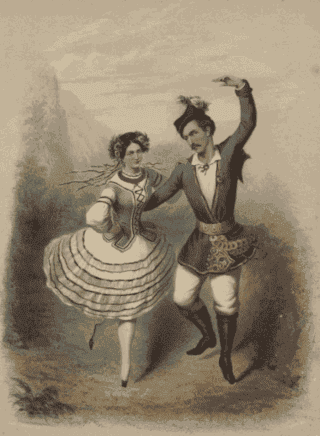
Picture 7. Engraving: Konstancja Turczynowicz and Feliks Krzesiński in the Krakowiak dance, 1852. Antoni Zaleski/Claude Regnier. Source: The National Museum in Warsaw.
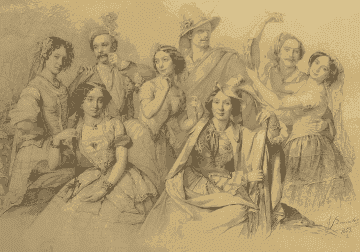
Picture 8. Engraving: Ballet artists of the Warsaw stage, 1853. Source: The National Museum in Warsaw.
The Wedding in Ojców was also presented by the Polish Ballet company, including performances on the French Riviera and at the World’s Fair in New York in June 1939, featuring Olga Sławska and Leon Wójcikowski (Leon Woizikovsky (1899-1975) was born and died in Warsaw. Leading soloist of the Ballets Russes, soloist of the Poznań Opera (1950–52), choreographer and teacher. At Ballets Russes, he initially danced in Aurora Borealis (choreography by L. Miasin, music from Rimsky-Korsakov's opera The Snow Maiden), Carnival (choreography by M. Fokin, music by R. Schumann), Polovtsian Dances (choreography by M. Fokin, music by A. Borodin), Scheherazade (choreography by M. Fokin, music by N. Rimsky-Korsakov), Tamara (choreography by M. Fokin, music by M. Balakirev), Petrushka (choreography by M. Fokin, music by I. Stravinsky), Daphnis and Chloe (choreography by M. Fokin, music by M. Ravel), Cleopatra (choreography by M. Fokin, music by A. Arensky), The Firebird (choreography by M. Fokin, music by I. Stravinsky), Narcissus (choreography by M. Fokin, music by N. Tcherepnin).
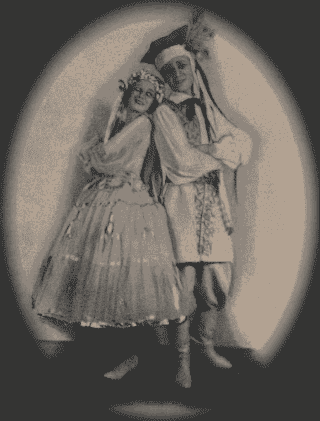
Picture 9. Anna Pavlova and Mieczysław Pianowski in Wesele w Ojcowie (The Wedding in Ojców). Engraving: Pani Magazine, 1923, No 6. Source: archive.org, accessed December 30, 2025.
After Diaghilev's death and the break-up of the Ballets Russes, he accepted an offer to join Anna Pavlova's company. He partnered her in Amarilli (choreography by I. Chlustin, music by A. Glazunov) and appeared in the roles of the Moor in The Oracle of the Dolls (music by J. Bayer), the Marquis in The Enchanted Flute (music by R. Drigo), a soloist in Spanish Dance (music by A. Glazunov), as well as in Invitation to the Dance (music by C. M. von Weber) and in Polish Wedding (Wedding in Ojców, music by K. Kurpiński, choreography by M. Pianowski). After Pavlova's death in 1931, he accepted Marie Rambert's offer to produce and perform in London in Afternoon of a Faun. He then produced Petrushka and danced the title role at the Lyceum Theatre in London.)
The legacy of the ballet after 1945
The Second World War resulted in the destruction of costumes, posters, and stage decorations, and the Grand Theatre in Warsaw was completely ruined. What endured, however, was the spirit of Polish ballet, which Piotr Zajlich revived shortly after the war, in 1946, at the Variety Theatre in Warsaw. In the post-war period, the Warsaw ballet company not only re-established its rightful place on the theatrical stage but also continued the artistic and emotional legacy of the ballet tradition that had developed in the eighteenth and nineteenth centuries. After 1945, one of the most significant stagings of Wesele w Ojcowie (The Wedding in Ojców) was created by the distinguished dancer and choreographer Witold Gruca, a pupil of Leon Wójcikowski. The premiere, held on 4 April 1976, became a highlight of the theatrical season.
The orchestra for Wesele w Ojcowie (The Wedding in Ojców) was conducted by Mieczysław Nowakowski, with set design and costumes created by Adam Kilian and lighting by Stanisław Zięba. The principal roles were entrusted to talented soloists of the younger generation: Barbara Rajska performed the role of Zośka, the bride, while Jerzy Barankiewicz portrayed Szczepan, the groom.
The role of the bridesmaid was performed by Renata Smukala, the maid of honour by Barbara Kryda, and the Best Man by Jerzy Graczyk. Krzysztof Szymański appeared as the groomsman, while Mariquita Compe portrayed Zośka’s mother. The Warsaw audience also witnessed one of the company’s most distinctive and accomplished artists, Ryszard Krawucki, in the role of the Organist.
The cast, composed of outstanding performers, ensured the ballet’s success and inspired confidence in its long-term inclusion in the theatre’s permanent repertoire. Indeed, Wesele w Ojcowie (The Wedding in Ojców), remained on the bill for more than ten seasons, with sixty-seven performances, each met with enthusiastic ovations from the audience. Its sustained presence in the repertoire also provided a platform for the development of ballet characters by some of the most renowned artists of the Grand Theatre in Warsaw.
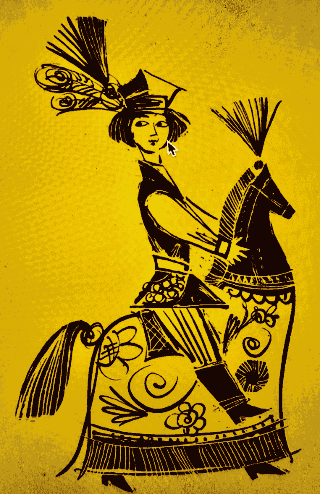
Picture 10. Engraving: Programme Wesele w Ojcowie (The Wedding in Ojców), Teatr Wielki in Warsaw, 1976
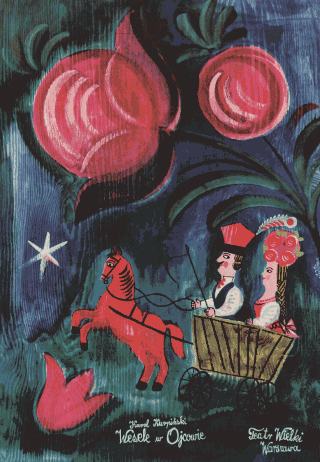
Picture 11. Programme, Wesele w Ojcowie (The Wedding in Ojców), Teatr Wielki in Warsaw, 1976
Ojcowie (The Wedding in Ojców), remained on the bill for more than ten seasons, with sixty-seven performances, each met with enthusiastic ovations from the audience. Its sustained presence in the repertoire also provided a platform for the development of ballet characters by some of the most renowned artists of the Grand Theatre in Warsaw.
The premiere of Wesele w Ojcowie (The Wedding in Ojców), choreographed by Witold Gruca, was met with great enthusiasm by critics. One review noted
And finally, Wesele w Ojcowie – the oldest of the Polish ballets that have retained their vitality to this day. It is fortunate that, after thirty years, it has returned to the repertoire of the national stage, bearing vivid witness to the venerable 200-year-old traditions of dance in Warsaw. Witold Gruca was also right to attempt a reconstruction of its form through diligent research into the movements of nineteenth-century productions. The result proved excellent [...]” ( Kański 1976)
In Gruca’s staging, the dramatic dimension, grounded in the original production, was prepared by Janina Pudełek, who emphasised that
while retaining its basic framework, the ballet underwent constant evolution in its details. (Pudełek 1976)
This principle applied to both nineteenth-century and later productions. The changes encompassed various aspects of the staging, including the opening scene. For example, the arrival of the invited guests was depicted differently depending on the production: on the large stage, guests arrived on horseback and in carriages; on smaller stages, the entrance was performed at a marching pace; and in the staging on the island in Łazienki Park, the guests made their entrance by boat. Certain elements, however, remained consistent across all productions, including the scene of the parental blessing, the departure and return from the church, the czepiny, the Krakowiak of the bride and groom, the solo mazur, and the Kraków pas de trois performed by the bridesmaids and two groomsmen.
The group dances – and, notably, the musical dimension – also underwent modifications. Pudełek’s primary aim was
the desire to bring the oldest monument of Polish choreographic art back to life. (Ibid.)
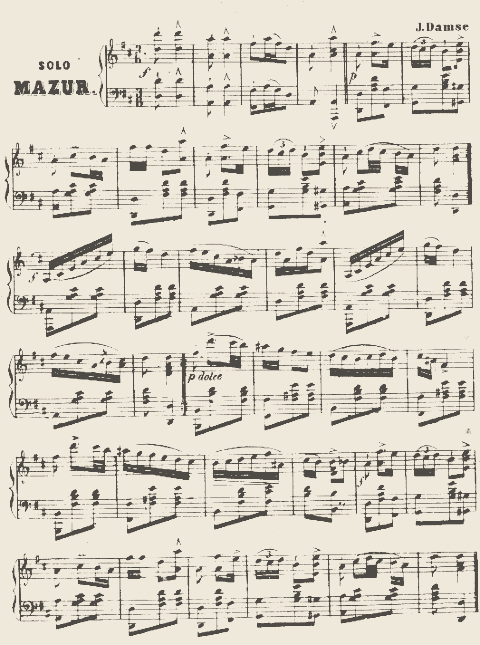
Picture 12. Musical notes of Solo-mazur, music by J. Damse, Polona (Wesele w Ojcowie). Source: polona.pl, accessed December 30, 2025.
However, she faced challenges in achieving this goal due to the limited surviving documentation. The extant fragments of the score revealed the heterogeneity of the music, reflecting the later incorporation of additional pieces by various composers, such as Józef Elsner, into the original composition, as illustrated by the 1860 version of the ballet presented above. Consequently, Pudełek proposed retaining the original music while supplementing it, where necessary, with other works by the same composers. She also recommended basing the libretto on the description provided by the ballet’s first reviewer, published in the Krakow periodical Muza Nadwiślańska in 1823 (Ibid.), and suggested expanding the pantomime scenes to incorporate the ritual customs of Kraków.
Pudełek also highlighted certain ideas drawn from Oskar Kolberg’s Lud polski (The Polish People). In their staging concept, the creators chose to enrich the plot with regional wedding customs that, while widely known, had not previously been presented on stage. Examples included the bride offering wreaths and candles to her bridesmaids, and the striking custom of matchmakers presenting the bride with bonnets, from which she selected the most beautiful (Wesele w Ojcowie, archival recording of the ballet, Teatr Wielki in Warsaw, 21.06.1985 r.). Gruca incorporated this dramatic layer to develop his own concept for the ballet, striving to align it as closely as possible with the aesthetic principles of Romanticism. The intention was to create a form of ballet suitable for the stage, rather than a literal reconstruction of a wedding ceremony, which could last up to a week. As Pudełek observed
Probably during the premiere in 1823, the original forms of folk dance were faithfully adhered to, and stylised motifs may have appeared around the 1840s, when ballet shoes were introduced to the stage. (Ibid.)
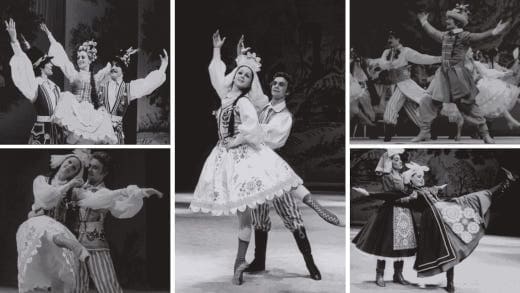
Picture 13. Wesele w Ojcowie (The Wedding in Ojców), Teatr Wielki in Warsaw. Dancers: Barbara Rajska, Renata Smukała,Barbara Kryda, Mariquita Compe, Jerzy Barankiewicz, Jerzy Graczyk, Krzysztof Szymański, and Ryszard Krawucki.
The decision to collaborate with Janina Pudełek, a prominent advocate of Polish national dances, proved highly promising. Pudełek found in Gruca a partner who deeply understood the essence of ballet performance, as demonstrated by his prior productions, which were distinguished by their artistic staging and refined choreography. Their collaboration left a lasting impact on the development of Polish ballet. In her article Choreographer, an Unknown Entity, Pudełek defined the choreographer as a creator who
has a comprehensive and in-depth knowledge of all stage dance techniques, professional musical knowledge, knowledge of drama and opera directing, art history, literature, philosophy and psychology, comprehensive knowledge of contemporary cultural life in all its manifestations, the situation in their country and what is happening in the world. (Pudełek 1977, 8)
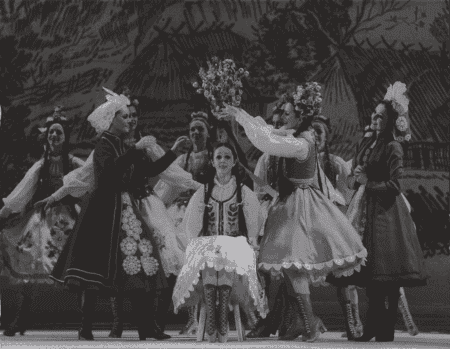
Picture 14. Wesele w Ojcowie, Teatr Wielki in Warsaw, 1976, Barbara Rajska.
Polish music, a thoroughly national libretto, and dances spanning over two centuries have elevated Wesele w Ojcowie (The Wedding in Ojców) to the height of its popularity, as evidenced by its hundreds of performances both in Poland and abroad. In 1976, Gruca produced a work that represented the peak of his choreographic mastery, presenting the story of Zośka, Szczepan, and the Krakowiaks of Ojców in a compelling and innovative manner. True to his guiding principle
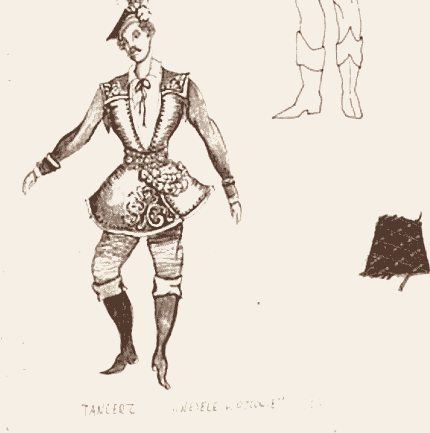
Picture 15. Wesele w Ojcowie (The Wedding in Ojców), costume design, 1976
It is not worth dancing ‘empty’; for the sake of dancing itself, one must tell a story through dance. (Witkiewicz op. cit., 19)
Gruca demonstrated both creativity and inspiration. He worked from a personal choreographic score legible only to him and treated dance as a medium for the expression of emotion and feeling.
Conclusion
Today, the ballet is performed by the Cracovia Danza company from Kraków. The author sincerely hopes that its subject will inspire future generations of Polish dancers and choreographers. Keeping alive the memory of Wesele w Ojcowie (The Wedding in Ojców) in Poland is a responsibility we all share.
References
- Ekiert, Janusz. 1976. “Kulisy.” Teatr April 25, 1976, No. 17.
- Fryś-Pietraszkowa, Ewa. 1988. Sztuka ludowa w Polsce [“Folk Art in Poland.”]. Warszawa.
- Gloger, Zygmunt. 1900. Rok polski w życiu, tradycji i pieśni [“The Polish Year in Life, Tradition, and Song.”]. Warszawa.
- Kański, Józef. 1976. “Polski wieczór” [“Polish Evening.”]. Trybuna Ludu April 28, No. 100.
- Komorowska, Małgorzata. 1975. “Witolda Grucy opowieści o człowieku” [“Witolda Grucy, Stories about Man.”]. Taniec. Poznań.
- Kunczyńska-Iracka, Anna. 1988. Sztuka ludowa w Polsce [“Folk Art in Poland.”]. Warszawa.
- Prokopek, Marian. 1988. Sztuka ludowa w Polsce [“Folk Art in Poland.”]. Warszawa.
- Przybylski, Tadeusz. 2007. “Znaczenie Kurpińskiego w polskiej kulturze muzycznej pierwszej połowy XIX wieku.” In Zabobon, czyli Krakowiacy i Górale [“Superstition, or Krakowiacy and Highlanders.”]. Warszawa.
- Pudełek, Janina. 1976. Wesele w Ojcowie [“Wedding in Ojców.”]. Ballet programme. Teatr Wielki in Warsaw, April 4, 1976.
- ____. 1977. “Choreograf – istota nieznana” [“Choreographer – Unknown Creature.”]. Taniec. Poznań.
- ____. 1968. Warszawski balet romantyczny 1802-1866 [“Warsaw Romantic Ballet 1802-1866.”]. Kraków.
- Sierpiński, Zdzisław. 1976. Życie Warszawy April 7, 1976, No. 83.
- Turska, Irena. 1989. Przewodnik baletowy [“Ballet Guide.”]. Kraków.
- Udziela, Seweryn. 2012. Krakowiacy. Kraków.
- Waldorff, Jerzy. 1976. “Muzyka Łagodzi Obyczaje.” Polityka, April 17, 1976, No. 16.
- Witkiewicz, Jan Stanisław. 2004. Grand jeté, czyli wielki skok [“Grand jeté, or the great leap.”]. Warszawa.
